How to Prepare Liposomes?

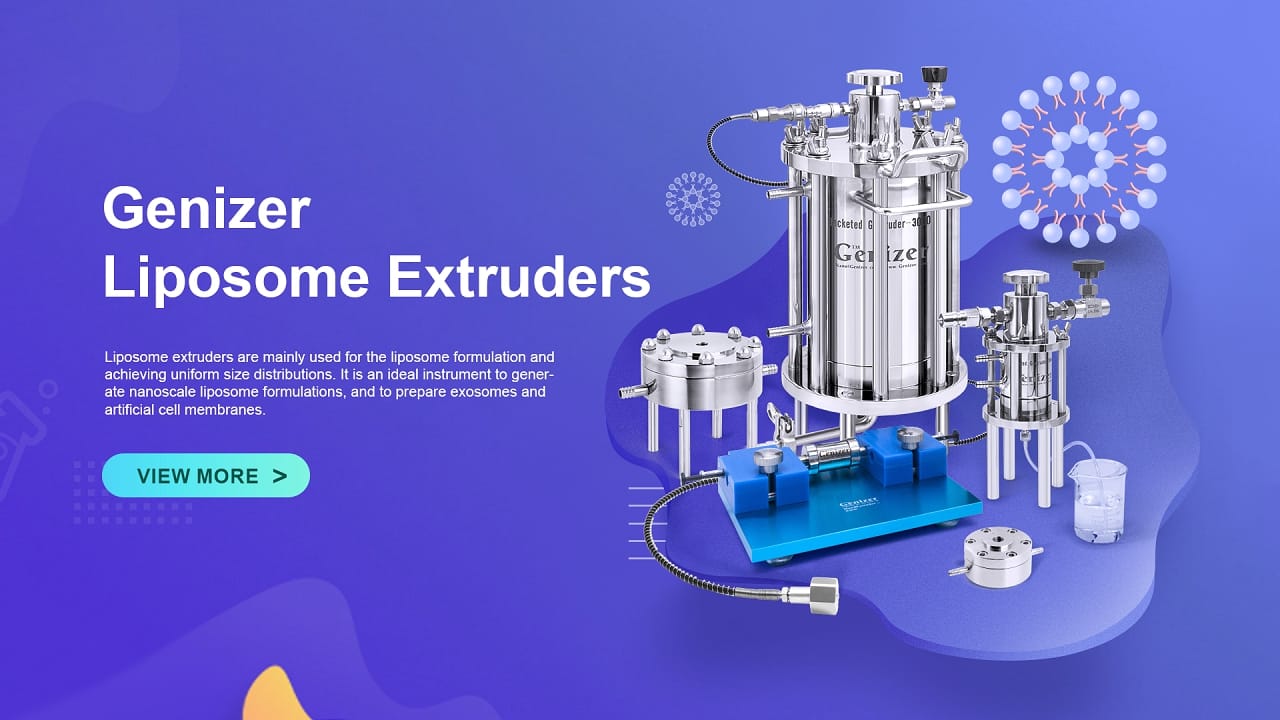
Liposomes, lipid-based spherical vesicles, are essential in pharmaceuticals, cosmetics, and food industries due to their ability to encapsulate both hydrophilic and hydrophobic compounds. Ensuring their stability and functionality depends on selecting the right method of preparation. One of the most effective methods for producing liposomes with uniform particle size and distribution is by extruding them through a filter membrane with a specific pore size, using a liposome extruder.
Methods to Prepare Liposomes
Several methods are used to prepare liposomes, each tailored for different applications. Below are the most widely used techniques:
1. Thin-Film Hydration
Thin-film hydration is a traditional and widely used method. It involves dissolving phospholipids in an organic solvent, then evaporating the solvent to leave behind a thin lipid film on the walls of a round-bottom flask. The lipid film is hydrated with an aqueous solution, forming large multilamellar vesicles (MLVs). These MLVs can be further downsized through sonication or extrusion to achieve uniform liposome size.
2. Sonication
Sonication uses ultrasonic energy to break down larger liposomes into smaller, unilamellar vesicles (SUVs). While this method is effective, it can generate heat, which may degrade sensitive compounds within the liposomes. This makes it less ideal for certain heat-sensitive formulations.
3. Microfluidization
Microfluidization is another high-tech method where lipids and aqueous solutions are forced through narrow channels under high pressure. This creates small, uniform vesicles. Although microfluidization produces precise results, it requires specialized equipment that may not be easily accessible in all labs.
4. Extrusion Through a Liposome Extruder
Liposome extruders are mainly used for the liposome formulation and achieving uniform size distributions. It is an ideal instrument to generate nanoscale liposome formulations, and to prepare exosomes and artificial cell membranes. By utilizing the tracked-etched filter membranes, the liposome extruders are capable of capturing large particles, precipitation and achieving sterile filtration.
Application: Research and Development for the liposomal drug delivery system, vaccine, gene delivery, and cosmetics
Working Principles: A liposome is a spherical-shaped vesicle composed of phospholipid bilayers. Phospholipid bilayers are critical components of cell membranes, with hydrophilic and hydrophobic properties. In an aqueous solution, the hydrophobic ends tend to bind to each other, and spontaneously form small spherical liposomes. The liposome extruder is designed for the preparation of liposomes. It is easy to use, and has high precision particle size control ability with narrow distributions and satisfactory repeatability. So far it has been widely used in the preparations of complex injectable liposome products.
Conclusion
Choosing the right method to prepare liposomes is key to ensuring the quality and functionality of the final product. While thin-film hydration, sonication, and microfluidization are useful techniques, extrusion through a liposome extruder stands out for its precision, scalability, and ease of use. If you’re looking to create liposomes for drug delivery, cosmetics, or research, the extrusion method offers superior results in terms of uniformity and efficiency.
Related Articles
High Pressure Homogenizer: Overview
Using NanoGenizer High Pressure Homogenizers for Nanomaterials and Cell Disruption
High Pressure Homogenizer vs Liposome Extruder, How to Choose?
High Pressure Homogenization vs Sonication: Which is Better for Your Liquid Formulation